Professional SMC Indicator: How to Choose One Worth Paying For
Which SMC indicator is best for TradingView? There is no single best SMC indicator for every trader. The best one for real money is the one that matches the method you trade and passes six tests — a named method behind every label, swings read from real market structure rather than a fixed number of candles, and dedicated IDM among them. A paid indicator is better only if it matches your method; a free general toolkit beats a paid tool built around a method you do not follow.
"Best SMC indicator" searches usually end in a list that ranks tools nobody tested against a stated standard. This article does the opposite: it defines what "professional" means first, then measures two kinds of tools against that definition, so you can decide which kind fits you.
If you searched for the best SMC indicator for TradingView, the best paid SMC indicator, or a premium SMC indicator, use the six criteria below as your filter: any tool that fails one of them is not the best choice for real money, no matter how popular its listing is.
For the full mechanics behind these tools — how swing detection works, what no repaint really means, and the BOS, CHoCH and MSS definitions — see the complete SMC indicator guide.
What "Professional" Actually Means Here
A professional SMC indicator is not the one with the most features on the chart. It is the one you can trust the same way every day, on every timeframe, without relearning what its labels mean. That trust rests on six criteria:
- A clear method behind it. The indicator follows one named set of rules, so every label on the chart comes from the same logic. A toolkit that plots generic elements without a method behind them leaves you to assemble the method yourself.
- Swings read from real market structure. Everything in SMC starts with swings. If the swings are wrong, every BOS, CHoCH, IDM and order block built on top of them is wrong too. A professional tool identifies swing highs and lows from confirmed price structure, not from a fixed number of input candles.
- Dedicated IDM (inducement). Inducement is the liquidity pool price is likely to sweep before the real move. A tool that maps it as a dedicated feature, together with structure, is doing more than plotting generic levels.
- Honest repaint behavior. Confirmed structure should never redraw. Live projected levels, by nature, update until they are confirmed. A tool that hides this distinction is not professional, no matter how clean its chart looks.
- A way to test before paying. A free trial, or a free version, so you can run it on your own charts before committing money.
- Support and a clear ownership model. Someone to contact when something breaks, and a price model you understand: rent access by subscription, own a lifetime invite, or own the source code outright.
Free Generic Tools vs Paid Method-Based Tools
The market splits into two groups. The free group is best represented by LuxAlgo SMC: a free Smart Money Concepts toolkit on TradingView, in the general SMC/ICT style. The paid, method-based group is best represented by JUKA, built around the Trading Hub 3.0 method. Neither group is "better" in the abstract. They serve different traders.
| Criterion | Free generic (LuxAlgo SMC) | Paid method-based (JUKA) |
|---|---|---|
| Method behind it | General SMC/ICT-style toolkit; no single named method tying the elements together | Trading Hub 3.0 method as one complete system: swings, BOS/CHoCH, IDM, premium and discount, sweeps and order blocks, all following the same rules |
| Swing detection | Fixed lookback window: swing length input, default 50 bars (internal structure: 5 bars). In a long sideways range, that window keeps firing labels on noise | Confirmed from real market structure, not a fixed candle count. No confirmed swing, no label, so long sideways ranges stay readable |
| IDM (inducement) | Not highlighted as a dedicated feature in its public description | Yes — dedicated IDM lines and labels, mapped together with structure |
| Repaint behavior | No repaint claim is made about LuxAlgo SMC in this article; check its script page and test on a live chart | Confirmed structure is never redrawn; live projected BOS/CHoCH/IDM levels update until confirmation |
| Price | Free on TradingView | Lifetime invite $60; full Pine Script source code $99 one-time |
| Trial | Not needed — the core indicator is free | Free 3-day trial via Telegram |
| Support and ownership | Maintained by LuxAlgo through its library | Support via Telegram; source code includes all v1.x refinements free, and may be customized for personal use (redistribution, resale, or republishing, modified or not, is prohibited under the license) |
The honest summary in both directions: the free tool covers more general SMC elements for $0 — BOS and CHoCH, order blocks, fair value gaps, equal highs and lows, premium and discount zones. That breadth is real, and for learning it is hard to beat. The paid tool goes deeper on one method — swings read from real structure, dedicated IDM, and the full Trading Hub 3.0 system in one indicator — and it charges for that depth and consistency.
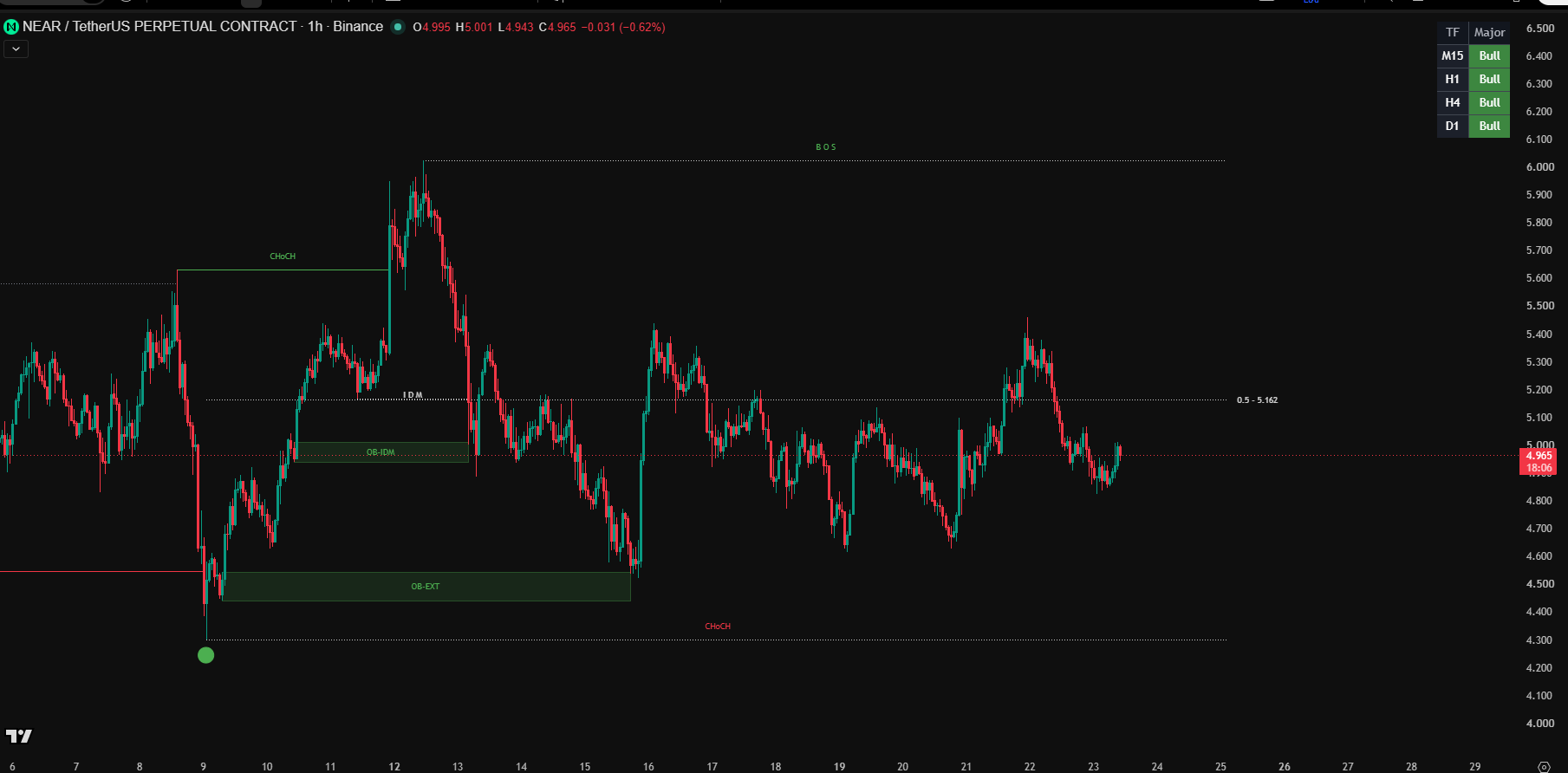
JUKA on NEAR 1H — every label drawn by the indicator.
Who Should Use the Free Tool
- You are still learning SMC and want to explore concepts on a live chart at zero cost.
- You prefer to assemble your own method from individual elements rather than adopt one named method.
- You are not committed to one specific method yet, and breadth matters more to you than consistency.
Who Should Pay for a Method-Based Tool
- You already follow a specific method — in this case Trading Hub 3.0 — and want it mapped automatically, in one system, instead of combining several tools.
- You trade ranges as well as trends, and you have seen fixed-window swing labels turn a long sideways market into noise.
- You want inducement mapped together with structure, not as an afterthought.
- You want a structural map where confirmed history never redraws, and you want to own the code or hold a lifetime invite rather than rent month to month.
The deciding question is not "which indicator has more features." It is "do I have a method, and do I need one tool to run it the same way every day?" If the answer is no, start free. If the answer is yes, a paid method-based tool is where the money goes.
Frequently Asked Questions
Is a paid SMC indicator automatically better than a free one?
No. A paid indicator is better only if it matches the method you trade. A free general toolkit beats a paid tool built around a method you do not follow. Match the tool to the method first, then compare prices.
Do I need the method or the tool first?
The method. An indicator cannot give you a method; it can only automate one. Learn the rules of the method you want to trade, then pick the tool that runs those rules without adding its own interpretation.
Do I need the invite or the source code?
The invite lets you use JUKA on TradingView. The source code license gives you the full Pine Script v6 code, which you may customize for personal use. Redistribution, resale, or republishing the code, modified or not, is prohibited under the license.
Try JUKA Free for 3 Days
If the Trading Hub 3.0 approach sounds like your method, test it on your own charts before paying anything. Contact us on Telegram at @hotayxanhvn for a free 3-day trial, or see the full details, pricing and license on the Trading Hub 3.0 indicator page.
Not financial advice.